
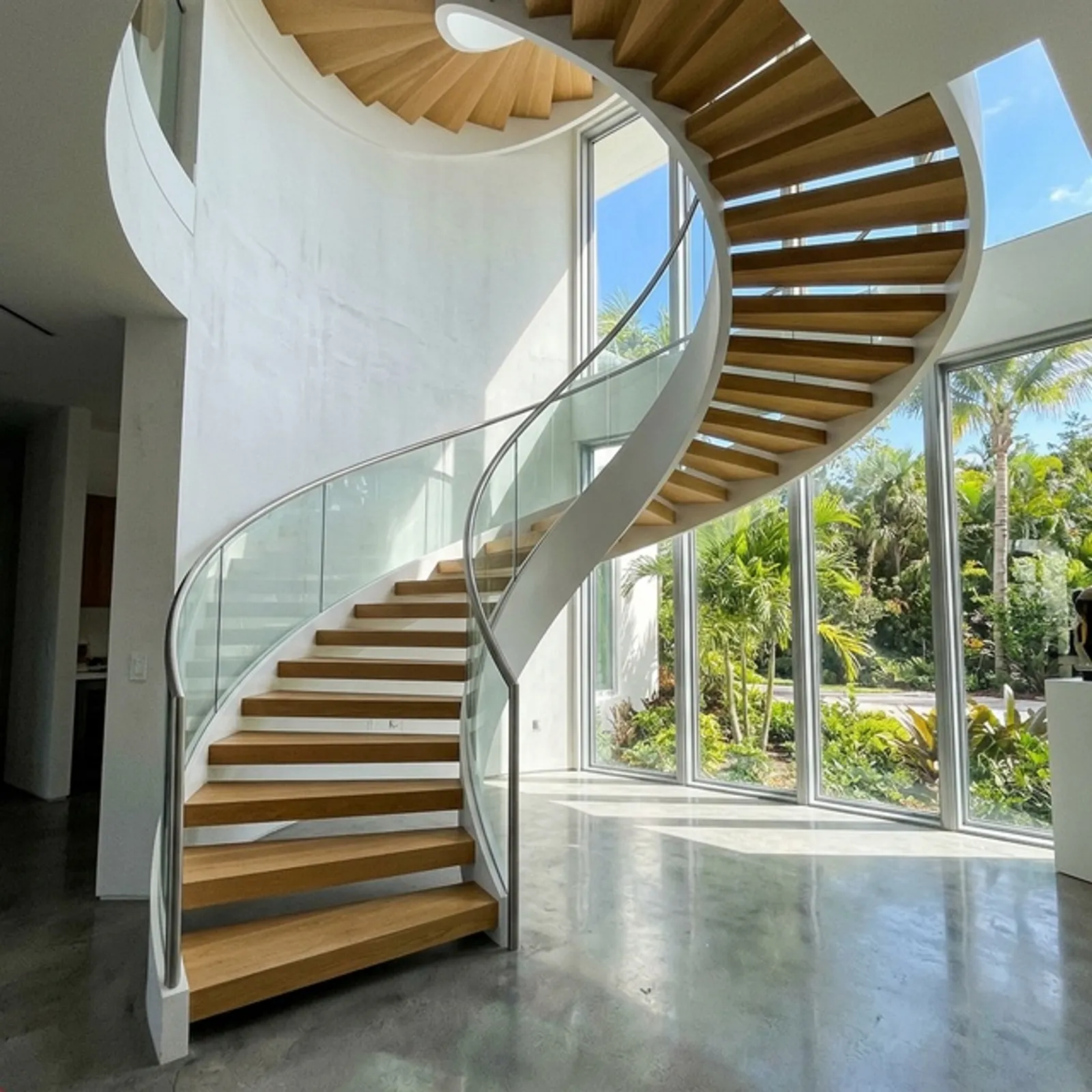
Curved Cantilevered Staircase Design in Houston, TX
Helical and elliptical floating stair designs built to 1/16-inch tolerance — work most Houston contractors won't attempt.
At Houston Floating Stairs , curved cantilevered stair work is the hardest thing we do — and the reason most contractors refer clients to us when the geometry gets complicated. A straight floating stair requires precise work. A helical or elliptical cantilevered stair requires all of that plus complex geometry that has to be right before the first piece of steel is cut.
Curved cantilever design starts in 3D modeling. We lay out the full helix or ellipse in software, check the geometry against your actual floor plan and ceiling height, and confirm the stringer path before we produce any shop drawings. This step catches conflicts — with ceiling soffits, structural beams, mechanical runs — before they become field problems. A conflict found in the model costs a few hours. The same conflict found during installation costs days and real money.
The fabrication tolerance on curved work is 1/16 inch across all control points. That sounds tight, and it is. On a straight stair, a 1/8-inch error can sometimes be absorbed in the tread mount. On a curved system, errors accumulate around the arc — by the time you reach the top landing, a small deviation at the bottom has compounded into a visible problem. We cut, bend, and check against the model at every stage of fabrication.
Most general contractors and even many stair shops decline curved cantilever work. The geometry requires CNC bending equipment and welders experienced with compound curves. We've done enough of this work in Houston — from River Oaks custom homes to Tanglewood renovations — to have a process that's repeatable. That's different from attempting it for the first time on your home.
Curved stairs also require more complex structural engineering documentation. The load path through a helical stringer is different from a straight mono-beam, and the anchoring pattern at the wall reflects that difference. Our engineering team produces the full stamped drawings for Harris County plan review — not a generic package that reviewers send back for revision.
Ready to get started?
Curved stair projects begin with a detailed site assessment and geometry review before any design or engineering costs are committed.
- ✓ Licensed & Insured
- ✓ 3D Geometry Verification Before Fabrication
- ✓ Harris County Permit-Ready Documentation
- ✓ In-House CNC Bending & Fabrication
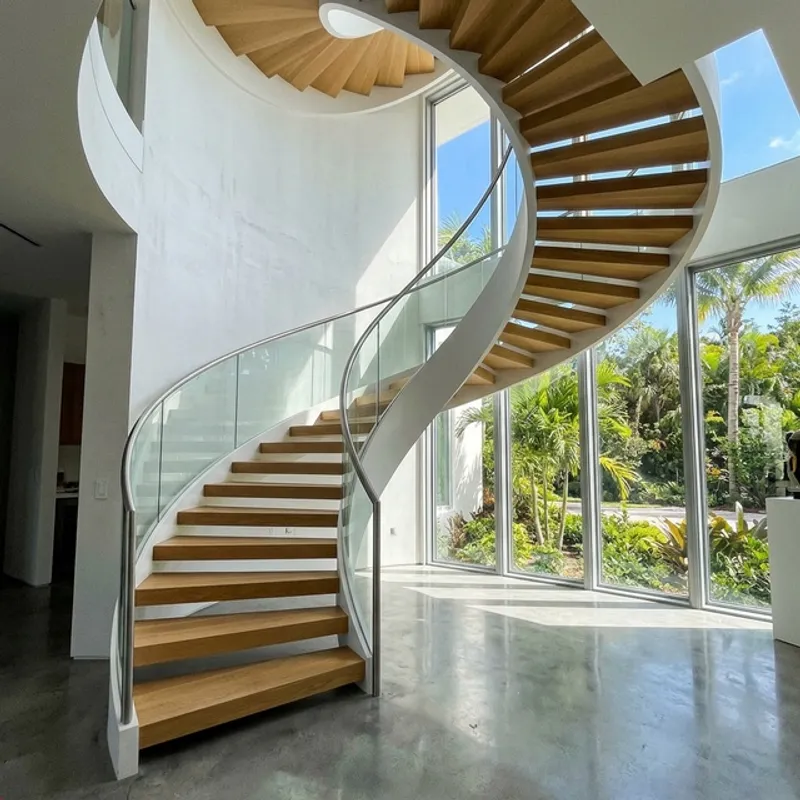
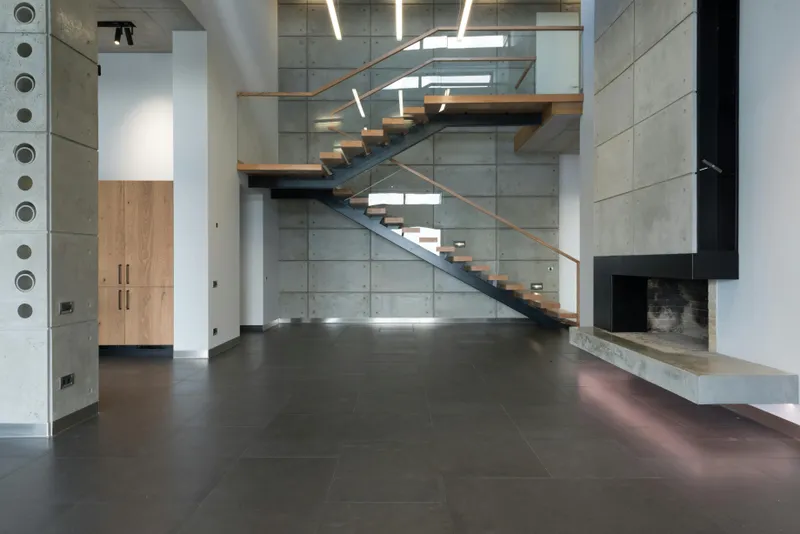
Curved Cantilevered Staircase Design — FAQ
Start Your Curved Cantilevered Stair Project in Houston
Geometry review. 3D modeling. Full engineering package. No vague estimates.